Open Dental Integration Setup
New to this? See why practices use Send It Secure with Open Dental → Send HIPAA-compliant, encrypted email from Open Dental.
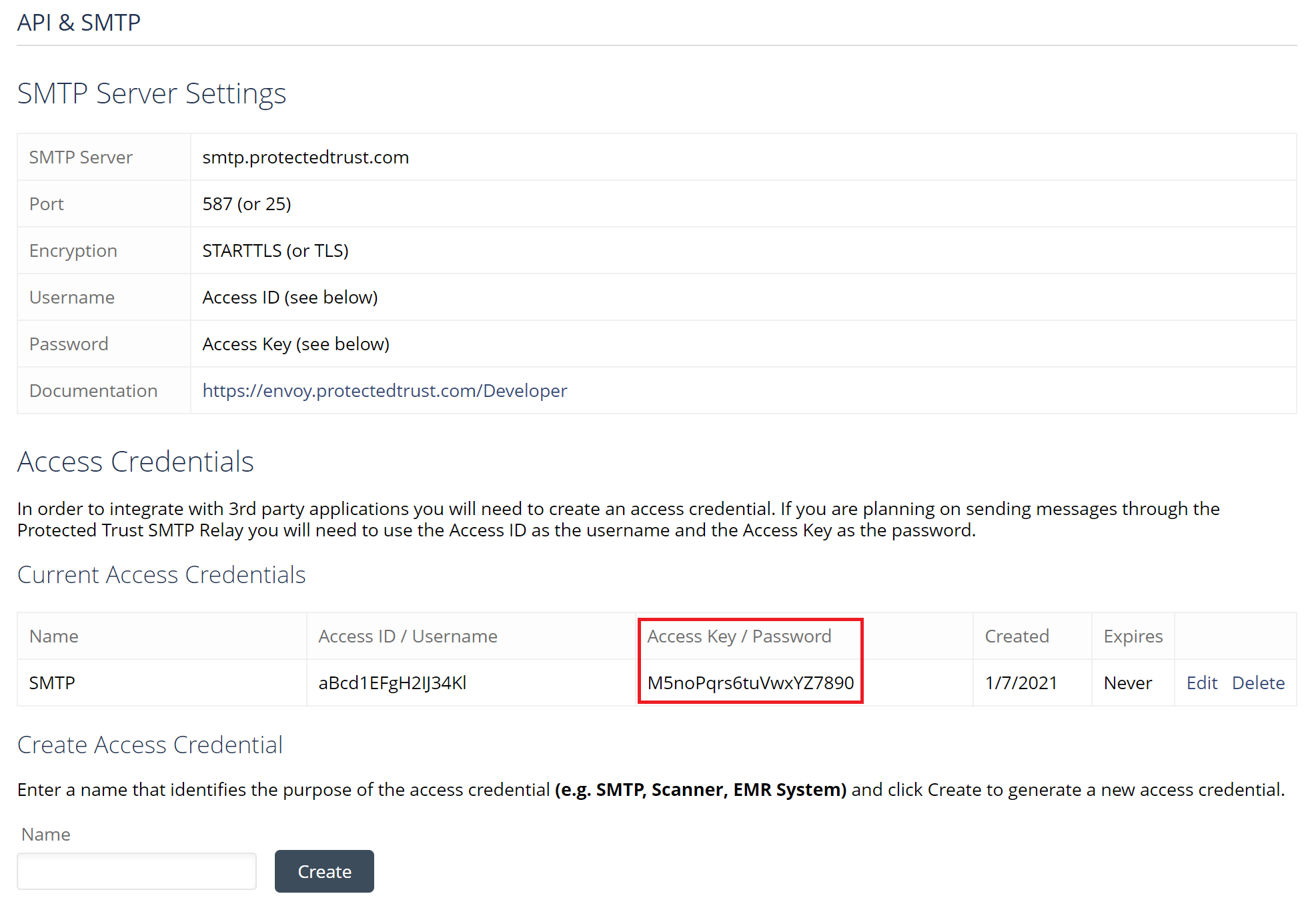
To send HIPAA-compliant, encrypted email through Send It Secure from Open Dental, you'll create an Access Credential in Send It Secure and enter it in your Open Dental Outgoing Email Settings. That credential acts as the username and password Open Dental uses to send.
|
Admin only. You must be an administrator to create an access credential on a user. |
Set up the integration
- Create an access credential in Send It Secure. Don't see the API & SMTP options (or the option to create an Access Credential) for this user? They may not be enabled for your subscription. Reach out at support.senditsecure.com and we'll review your subscription features and get it turned on.
- Keep the API & SMTP page open — you'll copy values from it in a moment.
- In Open Dental, open Email Setup (Open Dental reference).
- In the Email Addresses list, double-click the address you want to send from — or click Add to create one.
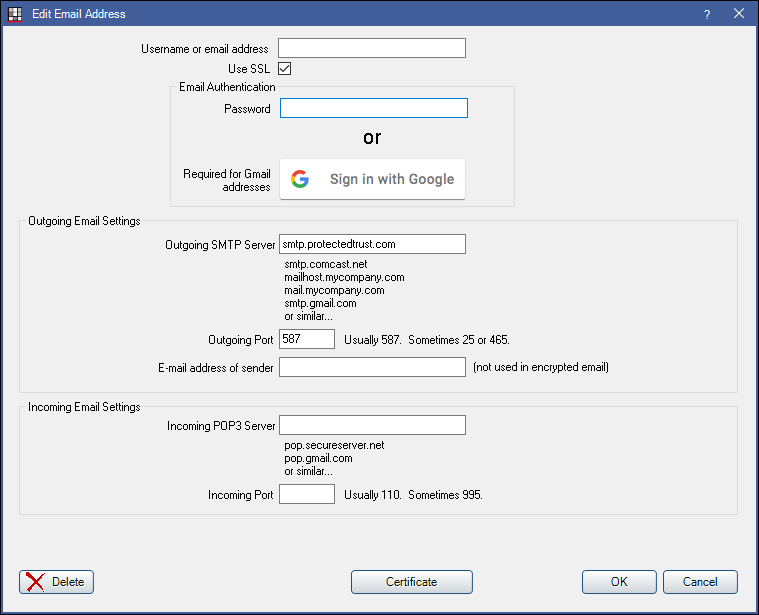
- On Edit Email Settings, enter the values below using the API & SMTP page you left open:
| Open Dental field | Enter |
| Username or email address | Your Send It Secure Access ID |
| Password | Your Send It Secure Access Key |
| Outgoing SMTP Server | smtp.protectedtrust.com |
| Outgoing Port | 587 |
| Use SSL | Checked |
| E-mail address of sender | The Send It Secure user's email address |
- Click OK to save the email address settings.
Troubleshooting
Open Dental (or an imaging / X-ray app) can't send — TLS / secure connection errors
This can affect Open Dental and other apps that send through SMTP — such as imaging, X-ray, or practice-management programs. If sending fails with a TLS or secure-connection error, the machine's .NET Framework apps may be falling back to older protocols. Confirm TLS 1.2 and TLS 1.3 are enabled, and that the enabled cipher suites match what our SMTP service requires — you can list them in PowerShell:
Get-TlsCipherSuite | Format-Table Name
Then set these registry values so .NET Framework 4.x uses strong cryptography and the system's default (modern) TLS versions. The WOW6432Node entries cover 32-bit applications on 64-bit Windows:
HKLM:\SOFTWARE\Microsoft\.NETFramework\v4.0.30319
    SchUseStrongCrypto        = 1   (DWORD)
    SystemDefaultTlsVersions  = 1   (DWORD)

HKLM:\SOFTWARE\WOW6432Node\Microsoft\.NETFramework\v4.0.30319
    SchUseStrongCrypto        = 1   (DWORD)
    SystemDefaultTlsVersions  = 1   (DWORD)
Restart the application (or the machine) for the change to take effect, then try sending again.
Still stuck? Open a ticket at support.senditsecure.com (or email support@senditsecure.com) and we'll help.